1. Introduction
In recent years, the new energy vehicle industry has developed rapidly, further increasing the requirements for new manufacturing technologies. Laser cleaning, with its advantages of non-contact, low-damage, and environmentally friendly characteristics, has gained favor in the new energy vehicle industry, and its application is gradually maturing. Taking the cleaning of KTL coating on a power battery box shell as an example, electric shock protection is a crucial aspect of the electrical safety design of power battery systems. All accessible conductive metal parts on the battery box shell must be equipotentially connected to the shell. Most commercially available methods use press-fit or bolt connections. If bolt connections are used, the contact surfaces cannot be painted or insulated; otherwise, the contact resistance will be too high, failing to meet requirements. Therefore, removing paint or coatings from the contact surfaces before tightening the balancing bolts is particularly important. Laser cleaning can effectively clean the KTL coating without damaging the metal surface plating. This article mainly provides an application case of Xiangming Laser's high-efficiency KTL coating cleaning production line in the new energy vehicle field, contributing to intelligent manufacturing.
2. Cleaning Requirements:
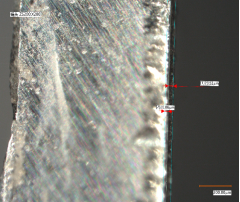
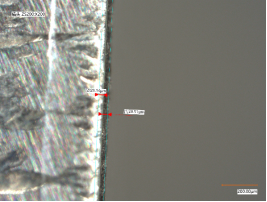
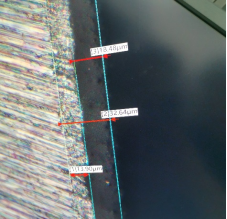
The laser cleaning surface needs to have a black KTL paint layer with a thickness <30μm and a zinc plating layer thickness ≥5μm, while preserving the zinc plating layer from damage.
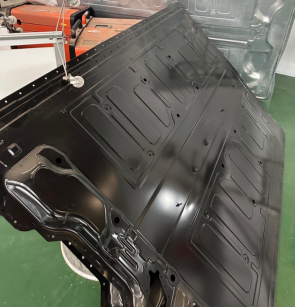 |
| Figure 1 Battery casing test plate |
Cleaning parameters:
A 200W fiber laser and a focusing field lens F254 were used. The following is a comparison of cleaning under different process parameters.
|
Number
|
Power (W)
|
Number of scans
|
Scanning speed (mm/s)
|
|
1
|
170
|
2
|
5000
|
|
2
|
170
|
2
|
6000
|
|
3
|
130
|
2
|
6000
|
|
4
|
130
|
3
|
6000
|
|
5
|
130
|
4
|
5000
|
|
6
|
130
|
10
|
5000
|
 |
 |
 |
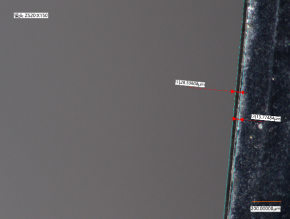 |
| Figure 2. KTL coating thickness inspection and zinc plating thickness inspection |
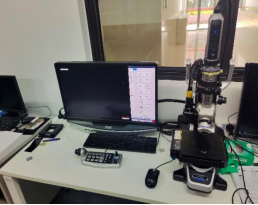 |
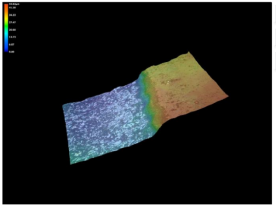 |
| Figure 3. Microscopic detection of cleaning thickness |
3. Equipment Introduction:
The KTL coating high-efficiency cleaning production line integrates coaxial rapid detection technology and fully closed-loop control transmission. Real-time data feedback enables intelligent and low-energy production. This production line has several advantages:1) High degree of automation, with a cycle time (CT) of less than 1 minute, meeting customer production line requirements.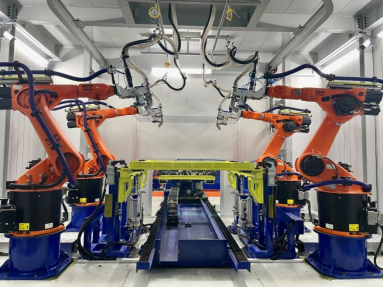
2) It enables selective area and layer processing without damaging un-cleaned areas, ensuring the micron-level zinc plating layer remains intact.
3) It provides stable cleaning quality and a high yield rate, enabling online quality inspection.
4) Through a vision positioning system, it achieves high-precision positioning of the processing area, with a positioning accuracy of 0.05mm.
5) Laser cleaning processing data can be recorded and saved in real time and can interact with and be traced through the workshop's MES system.
This production line has already been delivered and put into use at the customer's site, gradually realizing mass production of KTL coating cleaning for power battery casings. It will also be compatible with power battery box casing products of different specifications, helping more new energy vehicle companies to achieve intelligent manufacturing and industrialization.


