For decades, laser cleaning technology has matured and been widely applied due to its advantages such as non-contact operation, low damage, and environmental friendliness. However, the technology still has its limitations, and improving the cleaning effect (efficiency, cleanliness, etc.) has become a major challenge in the field.Currently, the mainstream cleaning equipment on the market is divided into nanosecond pulsed fiber optic cleaning machines and continuous laser cleaning machines. Pulsed laser cleaning produces high surface cleanliness but is relatively slow; continuous laser cleaning is more efficient but produces lower surface cleanliness.Analysis of the Mechanism of Continuous and Pulsed Laser Action
Figure 1: Temperature Distribution Cloud Map of Continuous Laser Rust Removal
Figure 2: Temperature Distribution Cloud Map of Pulsed Laser Rust Removal
Numerical simulation results of continuous and pulsed laser rust removal processes show that continuous laser sources cause the surface temperature of the rust layer to exceed 30,000 K, and the highest temperature on the substrate surface approaches 3,500 K; pulsed laser sources cause the highest surface temperature of the rust layer to reach 14,758 K, and the highest temperature on the substrate surface to reach 2,255 K. Comparative analysis shows that continuous laser sources have a stronger thermal effect, resulting in higher surface temperatures during rust removal and a greater tendency for thermal damage to the substrate. Pulsed laser sources have higher peak power, higher heating efficiency, and a faster temperature change rate, but the pulse duration is shorter, and the superposition of multiple pulse laser cycles causes multiple sharp temperature rises. Both methods result in substrate melting. After continuous laser rust removal, the surface shows a uniformly deep groove, while after pulsed laser rust removal, multiple laser spots form a crater-like morphology, with multiple protrusions appearing on the cross-section, and the depth of the craters gradually increasing.Comparative Test of Single and Combined Cleaning Effects of Continuous and Nanosecond Pulse Lasers500W nanosecond pulse equipment, 2000W continuous laser equipment, test workpiece: oxide scale from carbon steel weld seams.Table 1: Laser Cleaning Process Parameters
|
Serial Number
|
Average Laser Power (W)
|
Line Width (mm)
|
Cleaning Speed (mm/s)
|
Number of Cleaning Attempts
|
Cleaning Effect
|
Cleaning Time per Weld (s)
|
|
1#
|
500
|
40
|
5
|
4
|
Cleaned thoroughly, exposing the metal substrate.
|
240
|
|
2#
|
2000
|
40
|
30
|
2
|
Surface residue remains.
|
20
|
|
3#
|
500+2000
|
40
|
30
|
2
|
Cleaned thoroughly, exposing the metal substrate.
|
20
|
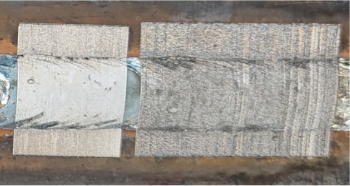
Figure 3. Effect of continuous and pulsed combined cleaning of oxide scale on carbon steel welds


